 Deutsch
 English
 Español
 Français
 Italiano
 Português
 Türkçe
 русский
 العربية
 한국어
한국어 中文
中文 日本語
日本語
- 29 April 2026
- JasonBramble
- Gaming Academy
I got asked this fantastic question recently:
“Why wouldn’t I just use prompts to generate trivia questions?”
It’s a fair question—and the honest answer is: you absolutely can.
If you just need a few trivia questions, prompting an AI works fine. But once you start creating trivia regularly—or at scale—the difference between prompting and a structured system becomes very real.
Let’s break it down.
🤖 Using Prompts for Trivia
Prompting is simple and flexible.
You type something like:
“Create 10 trivia questions about space exploration.”
And you get results instantly.
✅ Where prompts work well:
- Quick, one-off questions
- Exploring ideas
- Small batches
But prompts are essentially single-shot requests. And that’s where the limitations start to show.
⚠️ Where Prompts Start to Break Down
1. You’re Repeating Yourself
Need 50 reliable questions? That’s a lot of prompting - and a lot of your time. We can get it done in the time it takes to grab a cup of coffee.
2. Inconsistent Output
- Different formats
- Mixed difficulty
- Varying quality
You end up cleaning everything manually.
3. No Real Validation
You get an answer—but:
- Is it actually correct?
- Is it a good question?
- Is there only one correct answer?
You have to check that yourself.
4. No Workflow
Prompts don’t manage:
- Deduplication
- Retries on failure
- Quality control loops
- Organization of your content
⚙️ What Our Trivia Generator Actually Does Differently
This isn’t just “one prompt with better wording.” It’s a multi-step pipeline designed for reliability, scale, and organization.
Here’s what’s happening under the hood with the Gig Game Trivia Workflow:
1. Fact Generation (or Extraction)
We don’t jump straight to questions.
First, the system generates or extracts fact statements:
- From a topic
- Or directly from a webpage source (think your company products, a persons bio, or a recent news event)
If using a URL, the system:
- Pulls the page
- Cleans and structures the content
- Extracts facts strictly from that source
👉 This keeps trivia grounded in real content—not just AI guesses.
2. Fact Validation (with retries)
Each fact is:
- Checked for accuracy
- Revalidated if needed
- Dropped if it fails repeatedly
This creates a quality filter before questions are even generated.
3. Question Generation
Only validated facts are turned into questions.
The system supports the following formats:
- Multiple choice
- One-or-the-other
- Fill-in-the-blank
And ensures:
- Exactly one correct answer
- Plausible distractors
- Consistent structure every time
4. Question Validation
Each question is then checked to ensure:
- The correct answer is actually correct
- There’s no ambiguity
- The answer isn’t accidentally revealed
- It meets quality and content standards
If it fails → it gets rebuilt automatically.
5. Deduplication + Retry Logic
The system actively:
- Avoids duplicate facts - even checks for semantic similarity (not just exact matches)
- Retries failed generations
- Removes low-quality outputs
This is something prompts simply don’t handle.
6. Multi-Language + Translation Support
Our system supports 12 different languages, and can:
- Generate trivia directly in different languages
- Translate questions between languages
- Maintain structure and meaning across translations
This makes it easy to scale trivia globally without rebuilding everything manually.
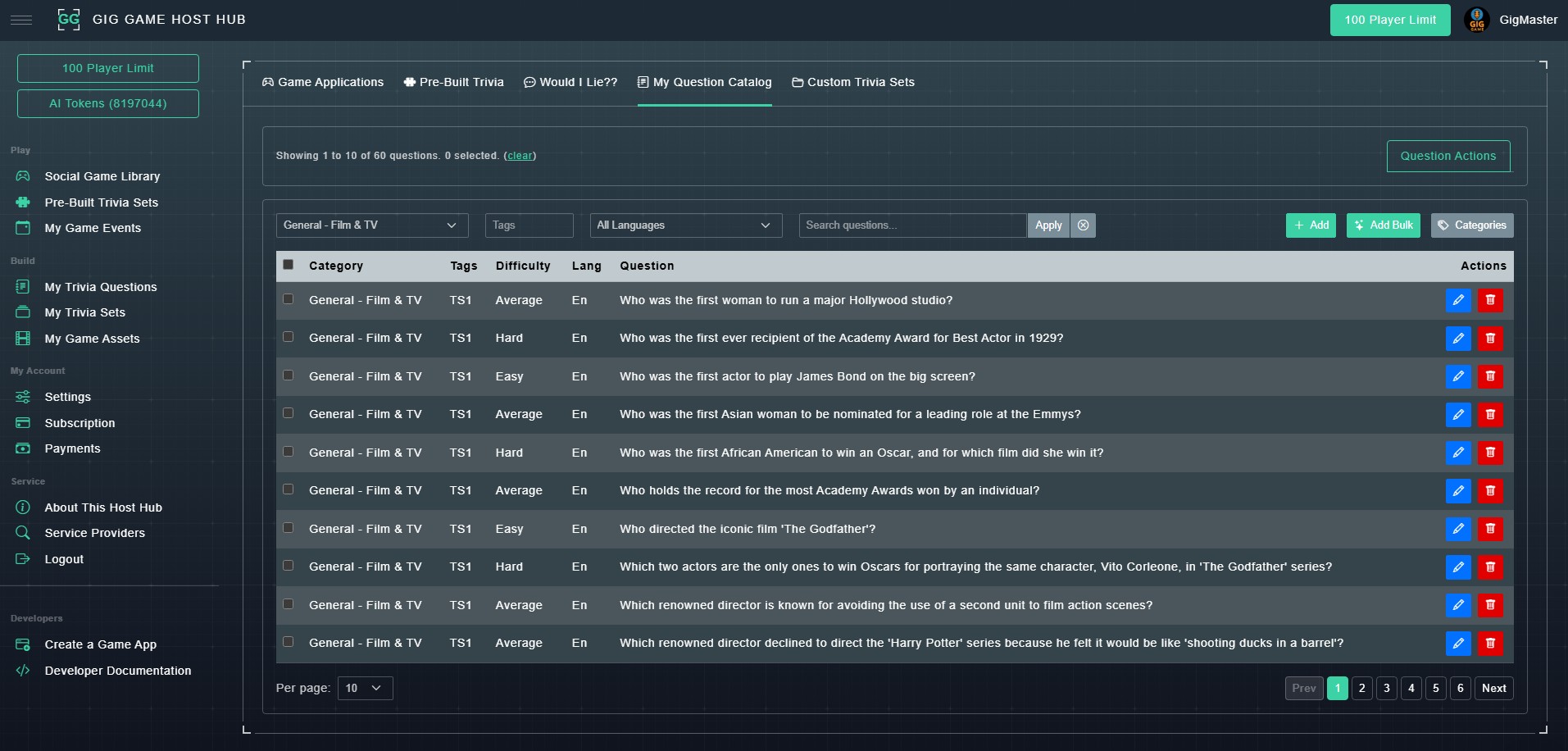
7. Content Organization Built In
Instead of copy/paste chaos, everything is:
- Categorized
- Tagged
- Stored and reusable
You’re not just generating trivia—you’re building a structured content library you can actually use.
8. Optional Image Generation
If enabled, each question can include an image that:
- Matches the theme - you choose the art style
- Does not reveal the answer
- Falls back intelligently if generation fails
🤔 So… Why Not Just Use Prompts?
You can.
But here’s the real difference:
| Prompts | Our System |
|---|---|
| One-off generation | Full workflow |
| Manual checking | Built-in validation |
| Inconsistent output | Structured output |
| No retries | Automatic retry + filtering |
| No organization | Categorized & reusable content |
| No source grounding | Can use real web data |
| Hard to scale | Built for scale |
| Manual translation | Multi-language support built in |
🎯 The Bottom Line
If you only need a handful of trivia questions, prompts are fast and convenient.
But if you’re:
- Building trivia regularly
- Creating content at scale
- Working across languages
- Powering games, apps, or events
Then the difference isn’t small—it’s time, consistency, and reliability.
💡 Final Thought
Prompts are a great starting point.
What we’ve built is what happens when you turn prompting into a repeatable, scalable system—one that validates itself, organizes your content, and works across languages without extra effort.